
What is the waist-to-height ratio and how do I use it?
Your waist-to-height ratio is your waist divided by your height, in the same units. NICE says to keep it under 0.5, meaning a waist under half your height. A ratio of 0.5 to 0.59 means increased health risks, and 0.6 or more means further increased risks. It applies to adults with a BMI under 35, of all ethnicities.
How do you measure your waist-to-height ratio?
Measure your waist midway between your lowest rib and the top of your hip, then divide it by your height in the same units.1
NICE's method, for adults:1
- Find the bottom of your ribs and the top of your hips.
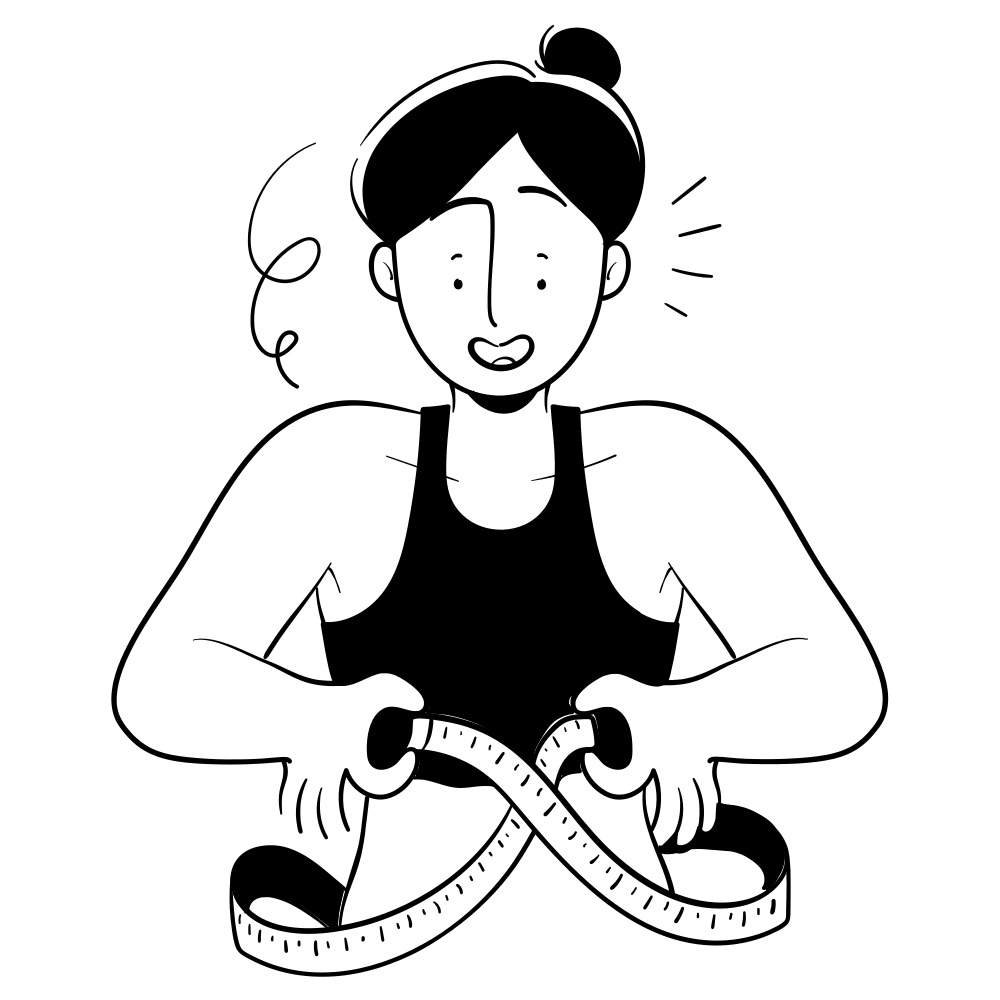
- Wrap a tape around your waist midway between them, which is just above the belly button.
- Breathe out naturally, then read the tape.
- Divide your waist by your height, both in cm or both in inches.
NICE's own example is 96.5 cm ÷ 170 cm = 0.57. In inches, that's 38 ÷ 67 (5 ft 7 in) = 0.57.1
What do the results mean?
NICE says a ratio of 0.4 to 0.49 means no extra health risk, 0.5 to 0.59 increased risk, and 0.6 or more further increased risk.1
The risks NICE names are type 2 diabetes, high blood pressure and heart disease.1 It asks health professionals to explain the target as keeping your waist to less than half your height.1 The same bands apply to men and women, all ethnic groups, and people with a lot of muscle.1 NICE uses them for adults with a BMI under 35.1 The example above, 0.57, is in the "increased" band. A 170 cm (5 ft 7 in) person would need a waist under 85 cm (33½ in) to stay below 0.5.
Why use it as well as BMI?
BMI measures overall size, not belly fat, so NICE says to use the waist-to-height ratio alongside it to judge health risk.1
NICE calls BMI a practical measure but says to read it "with caution" because it "is not a direct measure of central adiposity" (fat around the middle).1 It adds caution for people with a lot of muscle and people aged 65 and over.1
BMI cut-offs differ by ethnic group. For people with a South Asian, Chinese, other Asian, Middle Eastern, Black African or African–Caribbean background, NICE puts obesity at a BMI of 27.5, not 30.1 The waist-to-height bands stay the same for everyone.1 See Ethnicity and BMI.
Does it decide who gets Mounjaro or Wegovy on the NHS?
No. NICE's recommendations for Mounjaro and Wegovy on the NHS use BMI and weight-related conditions, and don't mention the waist-to-height ratio.2,3
NICE recommends Mounjaro (tirzepatide) from a BMI of 35 with at least 1 weight-related condition. Wegovy (semaglutide) needs a weight-related condition plus a BMI of 35, or 30 to 34.9 with specialist referral criteria. Both use thresholds 2.5 lower for the ethnic groups above.2,3 NICE says that if your ratio shows increased risk, you can ask a health professional for further checks, such as a heart and diabetes risk assessment.1 See What BMI do you need for Mounjaro in the UK?
Read the full picture
Related questions
Sources
- NICE. Overweight and obesity management. NICE guideline NG246, published 14 Jan 2025, updated 8 Jan 2026. Section 1.9 (recommendations 1.9.3, 1.9.5, 1.9.7, 1.9.8, 1.9.10, 1.9.11, 1.9.12, 1.9.14, 1.9.15 and Box 1). nice.org.uk
- NICE. Tirzepatide for managing overweight and obesity. Technology appraisal guidance TA1026, 23 Dec 2024, recommendation 1.1. nice.org.uk
- NICE. Semaglutide for managing overweight and obesity. Technology appraisal guidance TA875, 8 Mar 2023, recommendation 1.1. nice.org.uk
Last checked 12 Oct 2026 · Next review due 12 Oct 2027 · Report an error
How this answer was made. Written by the GLP Guidebook team from the sources above. It's general information, not medical advice. Talk to a qualified doctor before starting, stopping or changing any medicine. How we write