
How often should you weigh yourself on Ozempic or Mounjaro?
Once a week is the NHS (UK) weight-loss plan's suggestion. We found no schedule in the US Ozempic (semaglutide) or Mounjaro (tirzepatide) labels. A 2015 review found no clear difference between daily and weekly weighing. Big trials weighed people on the same scale each time. In one European study, weight swung about 0.35% within a week.
- GLP‑1 medicines such as Ozempic and Mounjaro are prescription-only in India, not sold over the counter.18
- A government statement on 1 Apr 2026 said only endocrinologists, internal-medicine specialists and cardiologists can prescribe them.18 CDSCO expert-committee minutes attach a similar condition to some approvals (endocrinologist or internal-medicine specialist), but we found no rule covering every brand.19,20
- The risks are in Guide 5: Side effects and risks.
- Nothing here promises any result.
Is daily or weekly weighing better?
A 2015 review of weight-loss trials found no clear difference in results between daily and weekly weighing.2
Added to wider programmes, weighing gave about 1.7 kg more loss. Alone, in the one trial that tested it, it made no clear difference.2 We found no study of weighing schedules in GLP‑1 users. The US Ozempic and Mounjaro labels set none.16,17
The NHS (UK) plan says weight "can fluctuate from day to day", so daily readings "may not give a true picture".1 In a European study of 1,421 adults, weight peaked from Sunday to Tuesday and dipped by Friday. The weekly swing was about 0.35%.4 That is about 0.3 kg at 90 kg. Another study called such weekend swings "normal".5
Can frequent weighing affect your mood or eating?
For most adults in weight-loss studies, regular weighing was not linked to depression, anxiety or disordered eating, two reviews found.3,6
A 2016 review did find a small link with poorer self-esteem and more stress. In younger samples, weighing was more often linked with disordered eating. Links were more negative where people lost less weight or weighed briefly.6 In 356 US teenage girls surveyed, frequent weighing went with lower body satisfaction and more unhealthy weight-control habits, but also more healthy ones. It predicted no change 9 months later. The authors said teenagers should not be encouraged to weigh often.8
Weighing trials have mostly left out people with a current or past eating disorder.7 In one group of women with eating disorders, many dieted harder after weighing, whatever the scale showed.7 The reviewers called one weighing rule for everyone "not sensible".7
How did the big trials weigh people, and when did weight level off?
In the STEP 1 weight trial, staff weighed people at clinic visits 2 to 8 weeks apart, on the same scale each time.9
It tested semaglutide 2.4 mg (Wegovy's dose, above Ozempic's 2 mg US maximum), weighing people without shoes, bladder empty.9,16 SURMOUNT-1 (tirzepatide for weight) set visits 4 weeks apart, some by phone. It weighed people fasting, in the morning, on the same scale where possible.10
In STEP 5, weight on semaglutide 2.4 mg levelled off after about week 60. At 2 years the average loss was 15%, against 3% on placebo (a dummy injection).11 In a Lilly-funded reanalysis of SURMOUNT-1, half had plateaued by week 24 to 36, depending on starting BMI.12 It counted under 5% change over 12 weeks, and staying that way, as a plateau.12
India's ESI 2025 guideline says a 3-month trial can test whether a medicine works and suits the person.13 NICE (UK) says to consider stopping semaglutide if under 5% of weight is lost by 6 months.14 Trial results are compared in our weight-loss post.
- Stomach effects are very common. In STEP 5, 82% on semaglutide 2.4 mg had stomach side effects, against 54% on placebo.11
- Pancreatitis and gallbladder problems, including gallstones, are listed warnings for semaglutide and tirzepatide.13
- Kidney injury is a listed warning too.13
- Not for people with a personal or family history of medullary thyroid cancer or MEN 2, or in pregnancy or breastfeeding, says India's ESI 2025 obesity guideline. Tell your doctor if any of this applies.13
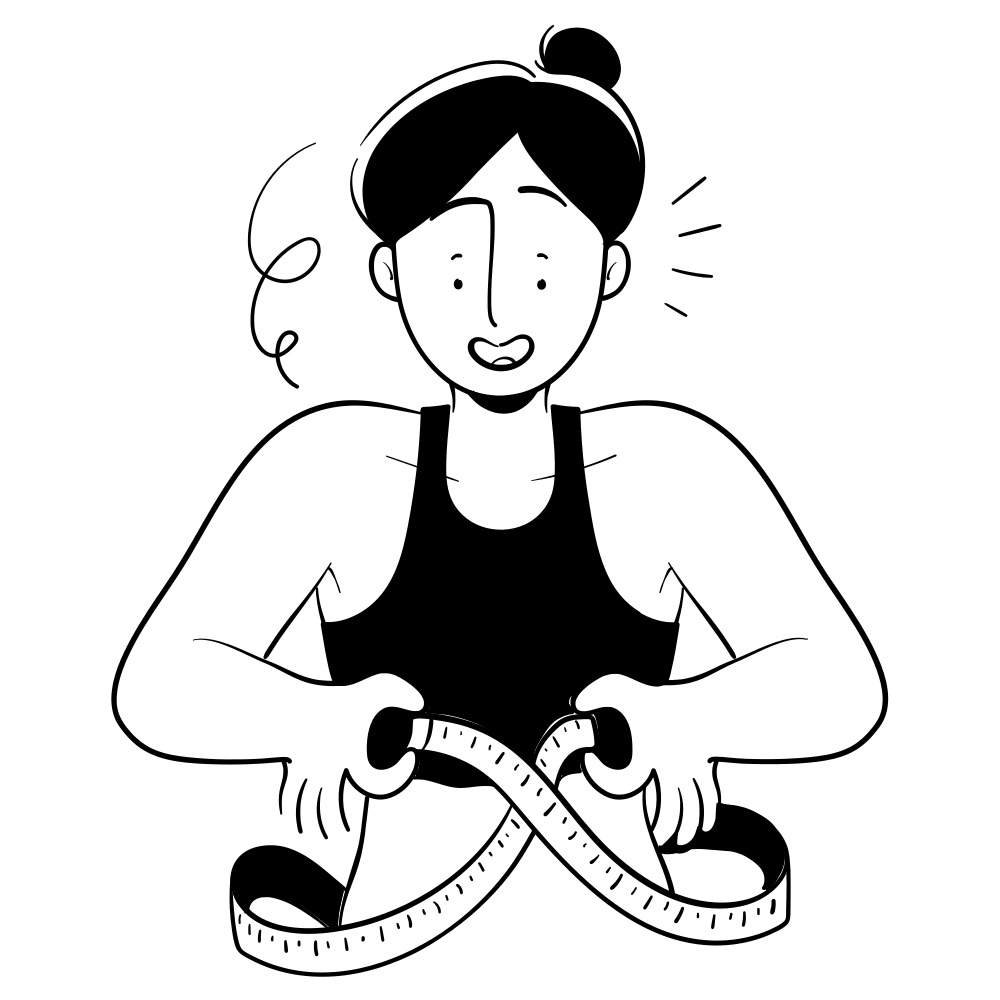
Why do Indian guidelines use waist size as well as weight?
India's 2009 obesity consensus says BMI and waist size should be used together, with equal importance, to judge health risk.15
It sets waist action levels of 90 cm (35.4 inches) for men and 80 cm (31.5 inches) for women. Above these, it advises seeking medical help to check for obesity-related risks.15 STEP 1 measured it standing, midway between the lowest rib and the hip bone, with the same non-stretch tape.9 More in Guide 1: Weight and health for Indians.
Read the full picture

Related questions
Sources
- NHS Choices (UK). Losing weight: getting started, 12-week weight-loss plan, weeks 1 to 12 (PDF). Written for general weight loss, not GLP‑1 medicines. assets.nhs.uk (PDF)
- Madigan CD, Daley AJ, Lewis AL, Aveyard P, Jolly K. Is self-weighing an effective tool for weight loss: a systematic literature review and meta-analysis. Int J Behav Nutr Phys Act 2015;12:104. doi:10.1186/s12966-015-0267-4 · PMID 26293454
- Zheng Y, Klem ML, Sereika SM, Danford CA, Ewing LJ, Burke LE. Self-weighing in weight management: a systematic literature review. Obesity 2015;23:256-65. Abstract. PMID 25521523 · doi:10.1002/oby.20946
- Turicchi J et al. Weekly, seasonal and holiday body weight fluctuation patterns among individuals engaged in a European multi-centre behavioural weight loss maintenance intervention. PLoS One 2020;15(4):e0232152. doi:10.1371/journal.pone.0232152 · PMID 32353079
- Orsama AL et al. Weight rhythms: weight increases during weekends and decreases during weekdays. Obes Facts 2014;7(1):36-47. PMC5644907 · doi:10.1159/000356147 · PMID 24504358
- Benn Y, Webb TL, Chang BPI, Harkin B. What is the psychological impact of self-weighing? A meta-analysis. Health Psychol Rev 2016;10(2):187-203. Excluded people diagnosed with eating disorders. PMC4917920 · doi:10.1080/17437199.2016.1138871 · PMID 26742706
- Pacanowski CR, Linde JA, Neumark-Sztainer D. Self-weighing: helpful or harmful for psychological well-being? A review of the literature. Curr Obes Rep 2015;4(1):65-72. PMC4729441 · doi:10.1007/s13679-015-0142-2 · PMID 26627092
- Friend S, Bauer KW, Madden TC, Neumark-Sztainer D. Self-weighing among adolescents: associations with body mass index, body satisfaction, weight control behaviors, and binge eating. J Acad Nutr Diet 2012;112(1):99-103. Abstract. doi:10.1016/j.jada.2011.08.036 · PMID 22717180
- Novo Nordisk. STEP 1 trial protocol (NN9536-4373), version 2.0, 21 Dec 2017: flowchart and section 9.1.1. Semaglutide 2.4 mg. Posted on ClinicalTrials.gov, NCT03548935. clinicaltrials.gov (PDF)
- Eli Lilly. SURMOUNT-1 trial protocol I8F-MC-GPHK(b): schedule of activities and appendix 7. Tirzepatide for weight. Posted on ClinicalTrials.gov, NCT04184622. clinicaltrials.gov (PDF)
- Garvey WT et al. Two-year effects of semaglutide in adults with overweight or obesity: the STEP 5 trial. Nat Med 2022;28:2083-91. Semaglutide 2.4 mg (Wegovy's dose). Funded by Novo Nordisk. doi:10.1038/s41591-022-02026-4 · PMC9556320 · PMID 36216945
- Horn DB et al. Time to weight plateau with tirzepatide treatment in the SURMOUNT-1 and SURMOUNT-4 clinical trials. Clin Obes 2025;15:e12734. Post hoc analysis funded by Eli Lilly; 8 of 10 authors are Lilly employees and shareholders. PMC12096058 · doi:10.1111/cob.12734 · PMID 39800653
- Madhu SV, Kapoor N, Das S, Raizada N, Kalra S. ESI clinical practice guidelines for the evaluation and management of obesity in India: an update (2025). Indian J Endocrinol Metab 2025. Text and Table 1. doi:10.4103/ijem.ijem_680_25 · PMID 40917319
- NICE (UK). Technology appraisal TA875, semaglutide for managing overweight and obesity, recommendation 1.2. nice.org.uk
- Misra A et al. Consensus statement for diagnosis of obesity, abdominal obesity and the metabolic syndrome for Asian Indians and recommendations for physical activity, medical and surgical management. J Assoc Physicians India 2009;57:163-70. PMID 19582986
- Novo Nordisk. Ozempic (semaglutide) US prescribing information, revised 05/2026. US label, not the Indian one: we found no public Indian label. novo-pi.com
- Eli Lilly. Mounjaro (tirzepatide) US prescribing information, revised 08/2026. US label, not the Indian one. pi.lilly.com
- PIB Research. GLP-1 drugs: use, risks, and regulation (government backgrounder), 1 Apr 2026. pib.gov.in (PDF)
- CDSCO. Recommendations of the Subject Expert Committee (Endocrinology & Metabolism), meeting of 20–21 Apr 2023, tirzepatide (Eli Lilly). cdsco.gov.in · archived copy
- CDSCO. Recommendations of the Subject Expert Committee (Endocrinology & Metabolism), meeting of 13–14 Feb 2024, semaglutide (Novo Nordisk). cdsco.gov.in · archived copy
Last checked 5 Oct 2026 · Next review due 5 Oct 2027 · Report an error
How this answer was made. Written by the GLP Guidebook team from the sources above. It's general information, not medical advice. Talk to a qualified doctor before starting, stopping or changing any medicine. How we write